
The space agency lines up GSLV-III and Chandrayan-II in 2017-18.

Chandrayaan-3's success is a must for India's space ambitions; we can't afford to lose out. And for realising our space dreams, the Indian private sector must be encouraged because if we lose this race, the moon, Mars, and mineral-rich asteroids will already be crowded before we reach there.

The space agency launched 104 satellites, breaking the previous record of 37 by Russia.
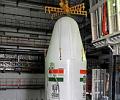
The launch of a Geosynchronous Satellite Launch Vehicle was called off by the Indian Space Reasearch Organisation at the eleventh hour on Monday due to a fuel leak in its second stage -- in a setback to the mission to test its homegrown cryogenic engine -- after its failure three years ago.

Since Pakistan has 'opted out' of the project, it is now being called South Asian satellite.

The Rs 978 crore mission, which has been rescheduled for Monday after scientists corrected the glitch in the rocket, will be launched at 2.43 p.m from the second launchpad at Satish Dhawan Space Centre, over 100 km from Chennai.

According to ISRO officials, Earth bound orbit is a phase during which the spacecraft will remain in the Earth's sphere of influence.

India's Polar Satellite Launch Vehicle will lift off from Sriharikota on July 10 taking five foreign satellites into orbit, including three earth observation spacecraft whose imagery will be utilised by a Beijing-based company as well as an experimental nano-satellite that will deploy a large, light-weight sail in order to hasten its descent back to earth.

They made history for India and the world.

Starting on Monday, the country's low-cost Mars mission that is in a rendezvous with the red planet for an extended period will enter the "blackout" phase snapping communication with the satellite.

India's observatory will be the fourth in space, after the Hubble, Russia's Spektr R and Suzaku of Japan.

A truly 'made in India' satellite that will empower a digital India.
The Vikram Moon Lander, named after the father of India's space mission Vikram Sarabhai on his birth centenary year, is scheduled to touch the lunar surface near its south pole on September 7 about 1.55 am.

"Efforts are underway to establish the link with the satellite," it added.

India's Mars orbiter has sent a picture of regional dust storm activities over the northern hemisphere of the red planet, Indian Space Research Organisation said on Monday.

A US court has asked Antrix Corporation, the commercial arm of Indian Space Research Organisation, to pay a compensation of USD 1.2 billion to a Bengaluru-based startup, Devas Multimedia, for cancelling a satellite deal in 2005.
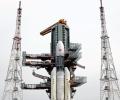
India's second mission to the moon will be launched on Monday at 2.43 pm after its initial launch on July 15 was called off owing to a "technical glitch."

"First orbit raising operation of GSAT-6 was successfully completed by firing the Apogee Motor for 3385 seconds at 8:35 pm IST on August 28," the ISRO said.
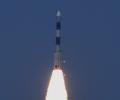
Prime Minister Narendra Modi lauded the scientists saying, "with this successful launch, we will determine our own paths powered by our technology".
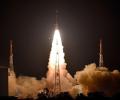
"I am really grateful to the entire ISRO family for having worked this hard and making IRNSS-1I a success," said the space centre's chief K Sivan.

The rocket is almost 49 meters high -- as much as a 17-floor building. It weighs 415 tons -- as much as the combined weight of 80 full grown elephants.

With the launch of GSLV-MK III, slated for April, it will be able to cater to bigger satellites as well.

Heralding a new era, India on Friday night launched its heaviest commercial space mission ever with its polar rocket successfully putting five British satellites into the intended orbit after a flawless takeoff.

Other than the Cartosat-2 series satellite, the PSLV is carrying 29 nano satellites from 14 countries - Austria, Belgium, Chile, Czech Republic, Finland, France, Germany, Italy, Japan, Latvia, Lithuania, Slovakia, the United Kingdom and the United States of America besides a nano satellite from India.
The mission has been extended by another six months due to surplus fuel
A S Kiran Kumar, chief of ISRO, said the mission was unsuccessful because the satellite housed within the heat sink could not be injected.

India's launch preparations for the ambitious Rs 450 crore Mars orbiter mission achieved a major milestone with the successful thermo-vacuum test of the spacecraft with its payloads (scientific instruments).

The ISRO lost communication with the satellite when it attempted to ignite the engine in a third and final move to its desired location.

A day after India successfully launched the Mars Orbiter in the Red Planet on its first attempt, it tweeted the first image it took and captioned it, 'the view is nice up here'.

It also carries equipment for meteorological data relay and satellite based search and rescue services being provided by earlier INSAT satellites.

India is set to operationalise its own navigational system with the successful launch of IRNSS-1D, the fourth in the series of seven navigational satellites, onboard PSLV-C27 from Sriharikota on Saturday.

The Indian Space Research Organisation has released a series of beautiful images of a canyon named Ophir Chasma and other physical formations on the surface of the Red Planet taken by the country's Mangalyaan Mars Orbiter.

Contributors to Team Indus project will have names etched on an object going to space.

Mission Shakti 'shows the development within India's military space programme, its desire to be seen as a global space power and its recognition of the potential dangers of China's counterspace programme.'

ISRO chief K Radhakrishnan spoke with rediff.com briefly before the launch of India's mission to Mars
The feat is the second one for the Indian Space Research Organisation scientists in using the indigenously made cryogenic stage after the January 5, 2014 launch of GSLV-D5.

While the Mars mission got wide praise, there were voices which questioned the need for spending Rs 450-500 crore on it when the country is facing hunger and poverty.
'China pumps in a lot more money than what we do. China's space budget is close to $5 billion while it is hardly $1 billion for us.' 'We manage the programmes within the constraints of our budget. The main difference is we prioritise.'

India successfully placed its spacecraft in orbit around Mars, becoming the first country in the world to succeed in such an inter-planetary mission in the maiden attempt itself.

'What we are trying for is to make space travel easier like air travel.' 'We have already established ourselves... the fact that other countries are coming to seek our help shows our technology is mature.'
